Recent Posts

Blades Brown Player Profile: Meet The Teenager Taking The Fast Track To The PGA Tour

Blades Brown has a name that sounds made for golf. His results are making it increasingly difficult to forget.

The Tennessee teenager has broken age records, earned national junior honors, and produced spectacular rounds against professional competition. Now, after securing PGA Tour membership for 2027, he has reached another important milestone: turning promise into a place on golf’s biggest regular stage.

But who is Brown, where did he come from, and what makes his development worth following? His story begins well before this year’s Korn Ferry Tour graduation.

Quick Facts

Born: May 21, 2007. Hometown: Nashville, Tennessee. Age: 19. Turned professional: December 17, 2024, at 17. School background: Brentwood Academy, followed by online studies. College golf: None. Golf Monthly biography, official PGA Tour biography

An Athletic Family And A Memorable Name

Brown’s first name has a family connection: Blades is his mother’s maiden name. It isn’t a nickname created to suit his golf career. PGA Tour player notes

His mother, Rhonda Blades Brown, played basketball at Vanderbilt before competing in the WNBA. As a member of the New York Liberty, she made the first three-pointer in league history during its inaugural game in 1997. She later coached girls’ basketball at Brentwood Academy. Brown’s older sister, Millie, also played college basketball. PGA Tour biography

Golf became Blades’ professional direction, but his background extends beyond one sport. His official biography notes that he earned a black belt in tae kwon do and grew up a Rickie Fowler fan, complete with Fowler’s signature orange clothing.

Those details offer a more rounded picture than the usual teenage-prodigy label: a young athlete with a competitive family background, other sporting interests, and favorite players of his own.

The Amateur Breakthrough That Put Him On The Map

Brown’s national breakthrough came at the 2023 U.S. Amateur, when he shared stroke-play medalist honors with Jackson Buchanan and Sampson Zheng. At 16, he became the championship’s youngest stroke-play medalist, surpassing the record associated with an 18-year-old Bobby Jones in 1920. USGA player background, official championship history

That achievement needs one important distinction: Brown was a stroke-play co-medalist, not the U.S. Amateur champion. Medalist honors determine the leading qualifiers before the championship moves into match play.

His progress continued in 2024. Brown earned medalist honors at the U.S. Junior Amateur, reached the U.S. Amateur Four-Ball final alongside Jackson Herrington, and received the AJGA’s Rolex Junior Player of the Year award. He also represented the victorious American team at the Junior Presidents Cup. AJGA award announcement, USGA Four-Ball final report

Watch: Grant Horvat vs. Blades Brown — Stroke-Play Match

Choosing Professional Golf Instead Of College

Brown considered the college route. His official biography lists recruiting visits to Florida State, Illinois, Stanford, Tennessee, and Vanderbilt. Ultimately, he chose to turn professional at 17 rather than play collegiate golf. His professional debut came at the 2025 American Express, where he missed the cut. PGA Tour biography

That was not his first PGA Tour appearance. As a 16-year-old amateur, he had already made the cut and finished tied for 26th at the 2024 Myrtle Beach Classic. His weekend rounds of 66 and 69 supplied early evidence that he could do more than simply participate against professionals. AJGA’s account of his Tour debut

Skipping college meant taking on the demands of professional competition early. The important question was no longer whether he could dominate junior events, but whether he could build results against experienced players over an extended schedule.

Learning The Professional Game

Brown’s 2025 season supplied a significant answer. He finished tied for second at the Veritex Bank Championship, shooting rounds of 61, 67, 66, and 63. The performance demonstrated the low-scoring potential that would become a recurring feature of his early professional career. Official tournament results

He finished that season 68th on the Korn Ferry Tour points list, earning membership for 2026 after beginning 2025 without status. That progression matters: before securing a PGA Tour card, he first established a platform from which to pursue it. PGA Tour’s 2025 pathway summary

There is a difference between a memorable sponsor-exemption appearance and earning opportunities through sustained performance. Brown’s development increasingly included both.

The Round Of 60 That Raised His Profile

On January 23, 2026, Brown shot 12-under 60 at The American Express on the Nicklaus Tournament Course. He narrowly missed a putt for 59, but still became the youngest player in PGA Tour history to record 60 or better. Golf Channel’s round report

His final tournament finish was T18, illustrating why one extraordinary round and a complete tournament performance are different measures. Nevertheless, the 60 showed an exceptional scoring ceiling.

Brown also finished third at the Puerto Rico Open that season. On June 2, the PGA Tour announced that he had accepted Special Temporary Membership, allowing additional sponsor-exemption opportunities for the remainder of 2026. That status was a stepping stone, distinct from the 2027 membership he later earned through the Korn Ferry Tour. Official PGA Tour announcement

Watch: Blades Brown’s 60 — Highlights And Interview

Making History At The Korn Ferry Finale

Brown’s next major milestone arrived on October 11, 2026. His runner-up finish at the Korn Ferry Tour Championship secured ninth place on the final points list and a PGA Tour card for 2027.

At 19 years, four months and 20 days, he became the youngest player to earn PGA Tour membership through the Korn Ferry Tour, breaking Jason Day’s graduation record. This is specifically a record for that pathway, not a claim that Brown is the youngest PGA Tour member through every possible route. Official graduation report

Brown shot 68–61–68–69 at The Federal Club, finishing two strokes behind Austin Hitt. Although he did not win the tournament, his week delivered the larger objective: promotion. Official championship recap

His Playing Style And What Comes Next

Brown’s results suggest a player with substantial low-scoring potential. A PGA Tour 60 and multiple Korn Ferry rounds in the low 60s provide stronger evidence of that potential than any broad comparison with an established superstar.

For a closer look at his technique, the best starting point is Brown’s own explanation rather than assigning him a swing label from photographs.

Watch: Blades Brown Explains His Swing — PGA Tour


The next test is turning that scoring potential into repeatable results across different courses, conditions, and tournament situations. Earning membership is an achievement, but it does not guarantee victories.

For GolfStrategyZone readers, that is what makes Brown worth following. His story already contains impressive milestones, but the most revealing chapter may be how he handles the ordinary demands between the extraordinary rounds.

Will Blades Brown become a PGA Tour winner in 2027, or will his first full season be primarily about learning?

Blades Brown Earns PGA Tour Card At 19 As Austin Hitt Wins Korn Ferry Finale

Blades Brown didn’t leave the Korn Ferry Tour Championship with the trophy. He left with something that could matter far more to his future: a PGA Tour card and a place in the record books.

At 19 years, four months and 20 days, Brown became the youngest player to earn PGA Tour membership through the Korn Ferry Tour. His runner-up finish secured ninth place on the final points list and promotion for the 2027 season. He broke the graduation record Jason Day established in 2007 at 19 years, 11 months and 23 days. Official PGA Tour graduation report

Meanwhile, tournament winner Austin Hitt delivered a different kind of breakthrough: turning the final event of the season into the victory that finally opened the PGA Tour door.

Brown’s Breakthrough Goes Beyond His Age

Teenage talent attracts attention. Earning a Tour card through a season-long points race requires something more substantial.

Brown’s graduation followed a campaign that included third place at the Club Car Championship and runner-up finishes at both the Tulum Championship and the season finale. Those results made his promotion more than a one-week story. PGA Tour graduate profiles

At The Federal Club in Glen Allen, Virginia, he also showed why his ceiling has generated so much interest. A second-round 10-under 61 helped put him in position to contend, and he entered Sunday with a one-shot lead over Hitt.

Brown closed with a 69, finishing two shots behind the winner at 18 under. The tournament victory escaped him, but the larger objective did not. Official championship recap

The distinction matters: Brown is the youngest Korn Ferry Tour graduate, not necessarily the youngest player ever to reach the PGA Tour through any route.

Hitt Turns The Final Week Into A Career-Changing Win

For Hitt, the championship began with less room for comfort.

The 28-year-old arrived at No. 22 on the season points list, outside the top 20 who would earn PGA Tour cards. By Sunday evening, he had climbed to sixth.

His closing five-under 66 delivered his first Korn Ferry Tour victory and a 20-under winning total. The decisive stretch came around the turn: birdies at the eighth and ninth, followed by a hole-out from 109 yards for eagle at the 10th.

Brown responded with four back-nine birdies, but Hitt held on, finishing with four consecutive pars. Golf Channel’s final-round report

One player made history early in his professional journey. The other earned his opportunity after years of working toward it.

The GolfStrategyZone Takeaway

There’s a useful lesson here for golfers whose own ambitions are measured in lower scores rather than Tour cards: one disappointing result doesn’t have to erase meaningful progress.

Brown lost the tournament but achieved a season-long goal. Hitt began the week outside the promotion places and finished with both a trophy and membership.

For amateur golfers, the equivalent might be a round that falls short of a personal best but includes better decisions, fewer penalties, or a stronger finish. Results matter, but they aren’t the only evidence that your game is moving forward.

The broader message is to keep competing for the opportunities still available. A difficult opening hole or a missed chance doesn’t settle the entire round.

What Happens Next?

Brown and Hitt join the 20 players who earned PGA Tour membership through the 2026 Korn Ferry Tour points list. Ross Steelman finished first in the standings, while Davis Lamb claimed the final promotion spot. Official graduates report

Graduation is an achievement, not a guarantee of what follows. But Brown’s record-breaking arrival and Hitt’s final-event breakthrough give golf fans two compelling careers to follow in 2027.

Is Blades Brown the young player you’ll be watching most closely next season?

Merion Becomes a U.S. Open Anchor Site: Why This Classic Course Still Matters

Merion Golf Club has earned a bigger place in the future of America’s national championship.

The USGA announced October 8 that the historic club in Ardmore, Pennsylvania, is its fourth U.S. Open anchor site, joining Pinehurst, Oakmont, and Pebble Beach. The designation strengthens a long-term partnership built around returning championships, advance planning, and investment in the tournament experience. USGA announcement

For golf fans, it means more opportunities to watch the best players compete at a course with an extraordinary history. For everyday golfers, Merion also offers a reminder that a demanding course doesn’t need an enormous yardage number to test your game.

What Does “Anchor Site” Mean?

An anchor site is a venue with a sustained commitment from the USGA to host future championships.

The association says these partnerships allow it to plan further ahead, invest in infrastructure, improve the experience for players and spectators, and build stronger relationships with host communities.

Merion’s designation formalizes its place alongside three of the championship’s most recognizable venues. It also gives the club and the USGA a framework for preparing for events decades into the future.

When Will Merion Host Again?

Merion’s upcoming major championships are:

YearChampionship
2030U.S. Open
2034U.S. Women’s Open
2040U.S. Open
2046U.S. Women’s Open
2050U.S. Open

The club lists all five on its official championship schedule.

These dates were already established before this week’s announcement. The USGA added the 2040 U.S. Open in January 2024, completing a once-every-decade men’s championship schedule through 2050. The latest news is the formal anchor-site designation. Earlier USGA announcement

A Course With Championship History Everywhere

Merion’s history includes some of golf’s defining moments.

Bobby Jones completed his 1930 Grand Slam there with a victory in the U.S. Amateur. Ben Hogan’s famous 1-iron approach on the final hole of regulation in the 1950 U.S. Open became one of the sport’s most recognizable images. Lee Trevino defeated Jack Nicklaus in a playoff in 1971, and Justin Rose won his first major there in 2013. USGA’s look back at Merion championships

The course’s wicker baskets, used in place of conventional flags, give it an unmistakable appearance. The USGA traces that tradition to the early years of the East Course and architect William Flynn’s work alongside Hugh Wilson. History of Merion’s wicker baskets

But its appeal extends beyond famous photographs and distinctive hole markers.

The 2013 Reminder: Yardage Doesn’t Tell the Whole Story

For the 2013 U.S. Open, Merion measured 6,996 yards. Despite that relatively modest championship length, its setup included four par 4s longer than 460 yards and three par 3s that could play beyond 235 yards. USGA course preview

Rose won at 1-over-par 281, two strokes ahead of Phil Mickelson and Jason Day. Official U.S. Open results

Those numbers describe the 2013 championship, rather than predicting the 2030 setup. Still, they show why judging a course by total distance can be misleading.

What Everyday Golfers Can Take From Merion

Our strategy takeaway is simple: evaluate the shot in front of you before deciding how aggressively to play it.

A shorter hole may still demand careful placement. A longer hole may require accepting a difficult approach and choosing a generous target. Total yardage tells you very little about the consequences of a particular miss.

On your next round, ask yourself:

  • Where does this tee shot leave the clearest approach?
  • Which side of the green gives me the easiest recovery?
  • Is chasing this flag worth the risk of a double bogey?

Those questions belong in a weekend foursome just as much as a major championship.

Merion’s next U.S. Open is scheduled for 2030. When it arrives, the interest will be in how a new generation of players handles a course that has challenged champions for more than a century.

Do you prefer the U.S. Open returning to familiar classics like Merion, or would you like to see more new venues? Share your take in the comments.

Jon Rahm Rejects LIV 2.0: What Happens Next?

Jon Rahm has made his position clear: he does not intend to play in the proposed next version of LIV Golf.

His next destination, however, remains unsettled.

During an October 7 bankruptcy hearing in New Jersey, Rahm’s attorney, John Beck, said the Spaniard had reviewed the proposed LIV 2.0 terms and found them unacceptable. Rahm and the league were negotiating a separation agreement, according to Front Office Sports’ reporting from the hearing.

For golf fans hoping to see Rahm back in regular PGA Tour competition, that is a significant development. But several steps still stand between his decision and a new tournament schedule.

What Exactly Is LIV 2.0?

LIV 2.0 is the proposed next chapter of a league undergoing substantial financial and structural change.

In its official explanation of the restructuring, LIV says it is winding down its existing operation while pursuing a new ownership model. Team competition would remain central, and players would have an opportunity to share in the business’s value.

LIV has also outlined plans for larger fields, a cut, and additional qualifying opportunities. Those are proposed changes. The league says a 2027 season remains subject to court and stakeholder approval, with no definitive event schedule announced in that statement.

That makes Rahm’s decision consequential. A league seeking a fresh start must persuade its biggest names to commit to the new terms.

Rahm’s attorney has now said those terms do not work for his client. The public reporting does not establish precisely which provisions drove his rejection.

Can Rahm Return To The PGA Tour?

A return is possible, but there is no confirmed agreement or starting date.

Earlier this year, the PGA Tour created a Returning Member Program that allowed Brooks Koepka to come back. Rahm was among the other eligible players but did not take that opportunity, according to Golf Channel.

The original program had a specific deadline: February 2, 2026. It applied only to the 2026 season. The Tour explicitly said the arrangement did not promise a similar pathway in future situations. PGA Tour program details

Koepka’s return therefore provides an example of what can be negotiated, rather than a standing offer Rahm can simply accept today.

Front Office Sports reports that, without a special arrangement, Rahm would not be eligible to return until at least August 2027, one year after his latest LIV appearance. Eligibility would still need to be resolved; that timing is not a confirmed comeback announcement.

The DP World Tour Offers Another Route

Rahm already has a connection to the DP World Tour.

In May, he reached an agreement with the circuit covering conditional releases for his remaining 2026 LIV appearances. That agreement helped resolve the dispute affecting his membership and Ryder Cup eligibility. Golf Monthly’s report on the agreement

Our assessment is that a schedule built around DP World Tour events is a plausible option while his PGA Tour status is settled. It would give him competitive opportunities through a circuit where he already holds membership.

That is a potential route, not an announced full-season commitment. Ryder Cup eligibility also does not guarantee a place on Europe’s team.

What Should Fans Watch Next?

The first development to watch is Rahm’s separation agreement. His attorney said the parties hoped to finalize it by October 15, with a court hearing targeted for November 5. Those are reported targets, not completed milestones.

After that, the key questions are straightforward:

  • Will the PGA Tour announce a return arrangement for Rahm?
  • Will he commit to a larger DP World Tour schedule?
  • Which players will accept LIV’s proposed new terms?

From a fan’s perspective, the appeal of Rahm returning to more events alongside golf’s other leading players is easy to understand. The challenge is agreeing on conditions that the tours, Rahm, and their existing members can accept.

Rahm has answered whether he wants to participate in LIV 2.0. The next announcement needs to tell us where we will see him tee it up.

Should the PGA Tour offer Rahm an earlier return, or require him to follow its existing rules? Share your take in the comments.

Nine Charities, One Scorecard: How the Generosity Cup Turned Rivalry Into $285,000 at Red Sky

Most charity golf tournaments follow the same script. One nonprofit, one field of foursomes, a silent auction, and a check presentation at the end. The Generosity Cup at Red Sky Golf Club in Colorado’s Vail Valley flipped that script, and the results speak for themselves: $285,000 raised in a single afternoon this July, more than double what the event brought in during its first year.

The twist that makes it work? The charities themselves are the competitors.

A Format Built on Friendly Rivalry

Instead of playing for one cause, the 2026 Generosity Cup fielded two teams for each of nine Vail Valley nonprofits, plus four independent squads, for 22 teams and 88 players in total. Red Sky turned over its Tom Fazio course for the afternoon of July 21, and every charity teed off knowing a strong finish meant a bigger share of the pot.

The stakes were real but the floor was generous. Every participating organization walked away with at least $25,000, with the top finishers earning more. Evans Scholars claimed the 2026 trophy in dramatic fashion, winning a scorecard playoff over Young Life, with the Eagle Valley Community Foundation taking third.

From a Late-Night Text Thread to a Six-Figure Event

The tournament is the brainchild of Trey Little and Kyle Van. Little serves as president of the Houston office of the National Christian Foundation, a grantmaking organization that helps donors direct money to charities, ministries, and churches. NCF runs an annual giving push called Generous July, and Little saw an opportunity to move the campaign somewhere cooler than a Texas summer: Colorado, where many of the foundation’s donors spend the season.

Van supplied the venue idea, Red Sky Ranch, and something more valuable: the competitive format. Rather than adding one more tournament to a crowded calendar, he proposed pitting local charities against each other on the course and raising money for all of them at once. He texted contacts at eight local nonprofits that same night. Within 24 hours, all eight were in.

Expectations started modest. Van figured the first event might clear $20,000 or $30,000. Barry Davis, a friend involved with the Dallas-based men’s ministry BetterMan, pushed the pair to aim for $75,000 to $100,000 instead. The 2025 debut, played with 12 teams, blew past even that number and finished at $137,000.

For 2026, the field grew again. Eric Reinhardt, a supporter of Junior Achievement, asked whether his organization could join, bringing the charity count to nine and the team count to 22. The stretch goal was set at $250,000. The event beat it by $35,000. As Van put it afterward, the generosity proved contagious, driven in large part by out-of-state summer residents who consider the Vail Valley a second home.

A Surprise Masterclass From Tom Watson

The day opened with burgers and hot dogs on the range, introductions of the nine charities, and then something no organizer can plan for: an eight-time major champion in a giving mood.

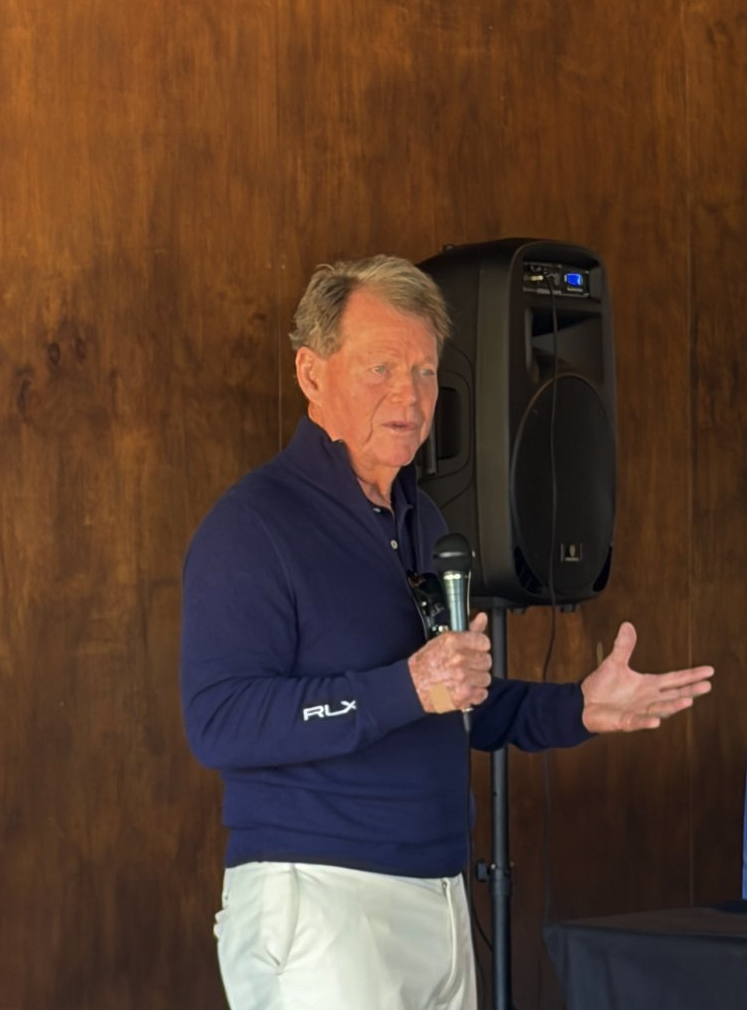
Tom Watson, fresh off a trip to the British Open, declined an invitation to actually play. Instead, the six-time PGA Player of the Year spent about 30 minutes speaking to the field and taking questions. He told stories about learning the game from his father, a devoted historian of golf, and joked about the family phone ringing with calls from Arnold Palmer and Jack Nicklaus looking to set up rounds when he was a rising young star. His parting advice to the players was simple: go have fun out there. He then posed for a photo with every one of the 22 teams before the shotgun start.

Why the Money Followed the Format

There’s a lesson here for anyone who runs or sponsors charity golf. The Generosity Cup solved two problems that quietly cap most fundraising tournaments.

First, it pooled audiences instead of splitting them. Nine nonprofits each brought their own donors, board members, and volunteers to a single event, which meant nine networks of givers in one room instead of nine separate tournaments competing for the same calendar dates and the same wallets.

Second, it gave donors a reason to care about the leaderboard. When a team’s finish determines how much its charity takes home, every putt carries a purpose, and supporters who might skip a generic scramble show up to defend their cause.

The community impact extends past the final scorecard. Ben Dodds, area director for Vail Valley Young Life, pointed to the middle and high school students who will benefit, and to the rare sight of nine local nonprofits being celebrated together on the same stage. John Welaj, executive director of Habitat for Humanity Vail Valley, noted that the participating organizations already collaborate throughout the year, and that a day spent together on the course creates a ripple effect of partnerships that outlasts the event itself.

The Nine Beneficiaries

The 2026 Generosity Cup raised money for the 4 Eagle Foundation, Ascend, the Eagle Valley Community Foundation, Habitat for Humanity Vail Valley, BetterMan, Evans Scholars, Junior Achievement, the Vail Veterans Program, and Vail Valley Young Life.

What Comes Next

Little and Van aren’t waiting to build on the momentum. The next Generosity Cup is already on the calendar for July 20, 2027, back at Red Sky. If the tournament doubles its total again, a single afternoon of golf in the Rockies will be pushing toward $600,000 for local causes. Little credits the 88 players who committed to the event and a simple idea behind it all: one event, nine charities, and a community that decided it’s better together.

This story is based on original reporting by Tricia Swenson for the Vail Daily.

How Shinnecock Hills Will Test the Best Players in the World

Shinnecock Hills is not just a famous U.S. Open venue — it is a thinking golfer’s test. The 2026 U.S. Open at Shinnecock Hills Golf Club gives fans a chance to watch how the best players in the world handle wind, firm turf, exposed greens, and uncomfortable recovery shots. More importantly, it shows the rest of us how smart strategy actually wins championships.

The official U.S. Open site lists Shinnecock Hills in Southampton, New York, as the host venue for June 18–21, 2026. Shinnecock is also one of the five founding clubs of the USGA, and 2026 marks its sixth U.S. Open. That blend of history and demanding architecture makes the course one of the most important strategic classrooms in American golf.

The central challenge at Shinnecock: a good miss

Most golfers think strategy begins with the perfect shot. At Shinnecock, it begins with the miss. When greens are firm and wind affects trajectory, even elite players miss their targets. The real difference is simple: a smart player leaves a miss that is still playable, while a frustrated player leaves one that is not.

For everyday golfers, this is the most useful lesson Shinnecock teaches. On every approach shot, pick a target that makes your most common miss less damaging. If your miss is short and right, do not aim at a right-side flag tucked behind a bunker. And if your long irons rarely stop quickly, do not chase a back pin with trouble waiting behind it.

Wind turns club selection into a discipline

Exposed championship courses make distance control harder, because wind changes both carry distance and spin. The best players respond by flighting the ball lower, taking extra club when needed, and avoiding emotional swings that add too much spin. Weekend golfers can borrow the same idea in a simpler form: when it is windy, swing smoother and choose a club that lets you finish in balance.

Why the short game decides U.S. Open scorecards

U.S. Open setups magnify short-game mistakes. A chip that finishes six feet away instead of two feet can turn a stress-free par into a defensive bogey attempt. At Shinnecock, players who miss in sensible spots still need creativity around the greens — but at least they have options. Players who miss on the wrong side often have no realistic way to stop the ball near the hole.

Three Shinnecock lessons for regular golfers

Shinnecock lessonWeekend-golfer application
Pick targets based on the safest miss.Aim away from the penalty that creates double bogey.
Control trajectory in wind.Take more club and make a smoother swing.
Accept pars as wins.Stop chasing every flag and protect your scorecard.

The smartest way to watch Shinnecock is to track decisions, not just results. When a player aims 25 feet from a tucked flag, that is often elite strategy rather than conservative fear. And when a player lays back from a dangerous angle, that choice may be exactly what keeps a championship alive.

Related reads on GolfStrategyZone.com

For tournament context, read our 2026 U.S. Open hub. For scoring context, see our U.S. Open cut-line guide.


Sources

This draft was prepared from official tournament resources, including the official U.S. Open site, the official U.S. Open qualifying page, the official U.S. Open tickets page, and the official Presidents Cup site.

Keep Reading in This U.S. Open Strategy Cluster

Use this article as part of the GolfStrategyZone.com U.S. Open strategy cluster: 2026 U.S. Open hub, Shinnecock Hills strategy guide, U.S. Open cut-line explainer, U.S. Open qualifying guide, and course-management lessons for weekend golfers.

FAQs about Shinnecock Hills strategy

What makes Shinnecock Hills difficult?

Shinnecock is difficult because wind, firm turf, exposed approach shots, and demanding green complexes work together. On a course like this, a small mistake quickly turns into a hard recovery rather than a simple two-putt.

Does Shinnecock reward power or accuracy?

It rewards both, but only in the right order. Power helps when it is controlled, while smart angles, disciplined targets, and reliable short-game execution matter even more around Shinnecock’s firm greens.

What can weekend golfers learn from Shinnecock?

The biggest lesson is to plan for your normal miss. A safe target hit with a committed swing almost always beats a risky target attacked with doubt.

Why do U.S. Open players aim away from flags?

They are usually protecting against the short-sided miss. A 25-foot birdie putt is often a far better outcome than a nearly impossible chip from the wrong side of the green.