[ad_1]
To buy or not to buy a lob wedge… that is a question so many golfers face.
If you want to play more consistently and lower your handicap, you need a solid short game. Studies have shown that even scratch golfers only hit about 50% of greens in regulation. While the average male golfer who keeps a handicap is 14.2 according to the USGA.
Needless to say, missing greens will happen for the rest of your playing career. Which is why it’s so important to develop a reliable short game that can help you save shots around the green.
Using the right wedges is part of the equation, along with proper technique and plenty of short game practice. But should you use a lob wedge? Is it worth it?
Let’s break it down…
Lob Wedge 101 – Does Every Player Need One?
Key Takeaways
- A lob wedge is the highest lofted club in the bag, with 58–64 degrees of loft.
- They have more loft than a sand wedge, are great for short sided shots, and very effective from the bunker. Not to mention a good weapon for partial wedge shots from 50 to 75 yards.
- Despite the advantages, there are plenty of downsides too… mainly that they’re not easy to hit consistently well for some golfers. Which can lead to all sorts of problems and wasted shots inside 75 yards.
Keep reading to learn more about different types of wedges, the pros/cons to a lob wedge, and how to hit consistently well.
What is a Lob Wedge?
A lob wedge is the most lofted club in the bag and has made golf so much easier for certain shots. They are a newer club that can be traced back to the 1980s. Short game guru Dave Pelz made these clubs very popular and advocated students to use them for help around the greens.


Pros of a Lob Wedge
So, what are the pros to using a lob wedge?
First is high trajectory shots. A low wedge is designed to hit high shots that hit the green and stop quickly. They’re great to use when you’re short sided and need to hit over a bunker, water, tree, or other obstacle.
They’re also very versatile around the greens, as you hit all types of shots. You can hit flops, greenside bunker shots, chips, and low spinners if you have the right lie.
These wedges create tons of spin too and ideal for 50-75 yard shots… if you have the proper form.
Cons of a Lob Wedge
As you can tell, there are a lot of pros but as I mentioned, you need the right form. Otherwise, these clubs can turn from a weapon to a liability and lead to a lot of frustration on the golf course.
The high loft (58–64 degrees) makes it easier to hit thin and fat shots. With the wrong form, you might thin it over the green and/or have the ball “ride” up the face, resulting in a chunked shot.
They’re also not great for full shots, as you need perfect timing and proper setup technique. Otherwise, you’ll make inconsistent contact and end up way off the green.
These clubs can also lead to gapping issues, so you’ll need to learn how to hit more partial wedges. Since you can only have 14 clubs in the bag, you might need to replace a hybrid, long iron, or fairway wood as well.
Finally, you need the right bounce to match course conditions (more on that below). Otherwise, a lob wedge might not match the firmness or softness of your courses and lead to consistency issues.
How to Hit a Lob Wedge
If you’ve decided a lob wedge will benefit your game, let’s get into how to hit one effectively.
Let’s start with ball position, as this is a huge mistake most golfers make. You do not need to “help” the ball up, this club has more loft than any iron or wedge. So please, do not play it off your front foot!
Instead, play it in the middle of your stance for the majority of full shots. Second, make sure you get more weight on your lead leg so you do not sway. You want to rotate around your body.
Finally, make sure to not take a long backswing. This is not a distance club, so don’t try to max out a lob wedge and hit it 100 yards. Instead, make controlled, smooth swings.
When it comes to hitting a lob wedge for short game shots, I’ll refer you to one of the best players ever.
Phil’s Advice on Pitching With Lob Wedges
When it comes to short game, make sure to listen to the pros for tips… especially short game guru Phil Mickelson. According to Phil, when you’re around the greens and decide lob wedge is the play, you need to make a choice. You must decide high or low – there is no in between.
As he mentions in this video, you must pick which shot so you can address the ball properly. If you’re going with a higher shot that lands and stops quickly, play it off the front of your foot with more weight forward. If you’re going with a lower shot that skips a few times then spins, play it more in the back of your stance.
Like Phil said, “It’s never in between your feet. Ever. Because if it’s in between your feet now, you can’t put your weight forward, or you’ll go over the top of it.” Later saying you can’t hit it high or low with that type of setup.
Please remember, this epic advice from Phil is only for short shots around the green, not 50-100 yard shots.

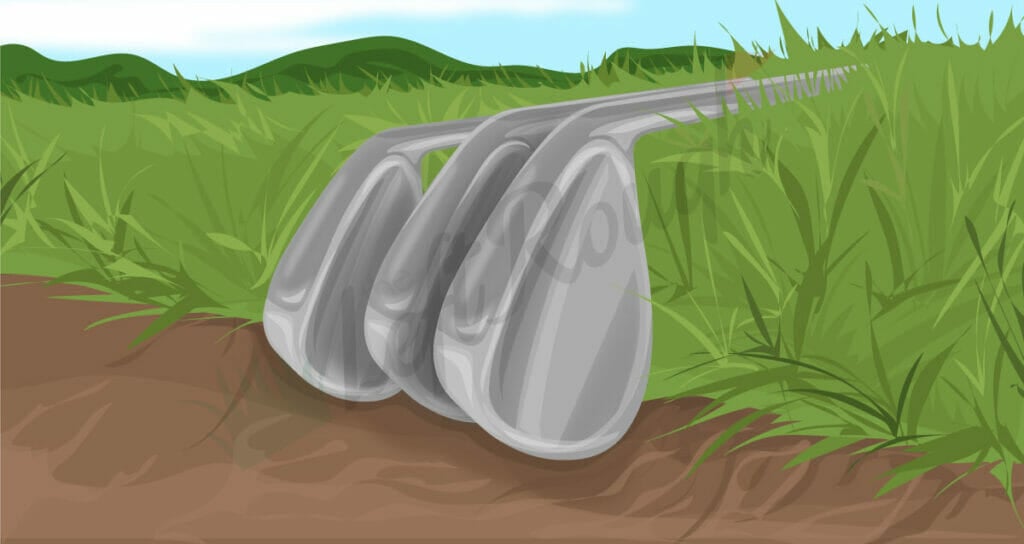
Different Types of Lob Wedges
Now that you know how to hit a lob wedge for the most common shots, let’s briefly discuss the type of lob wedges.
Loft and Bounce
Loft is the first thing to consider when buying a lob wedge. Lofts will range from 58 to 64 degrees, but if I’m being honest, there is almost no need for 62 or 64 degrees.
I tried a 64 degree out before and ended up selling and replacing with one that had 60 degrees of loft. It wasn’t very practical and barely could hit it more than 75 yards. Most golfers will benefit from a lob wedge with 60 degrees of loft.
The bounce is the other factor… which can range from low bounce (4 degrees) to high bounce (12 degrees). You can learn more about bounce here, but most golfers will benefit from mid-bounce, 8–10 degrees. This makes it versatile from a variety of lies, grass types, and sand conditions.
Club Head Design
The second thing to consider is the design of the club. Most pitching wedges match your iron sets, while some gap wedges do too. However, a LW and SW are typically purchased separately.
However, it’s a good idea to match the head to the rest of your clubs. If you’re a low handicapper, you can use a blade type design like the Titleist Vokey. If you’re a mid to high handicapper, you might consider a more forgiving design like the wedges from Cleveland.
Full Face Grooves
The final aspect of a lob wedge is the grooves. Some lob wedges have traditional grooves in the center of the face, while others have full face grooves. These extend the grooves all the way to the toe and might be a better solution for less consistent golfers.

My Experience
A lob wedge is a valuable club that can help your game a ton… if you have the right form and club that matches your game. If you’re new to golf, avoid them for now as you progress in your golf journey. But if you are a consistent golfer and even getting into competitive events, I would highly recommend a lob wedge.
As a plus handicap, I use my lob wedge a ton – both in practice and during tournaments. They’re great for short sided shots, it’s my go-to club for greenside bunkers, and perfect for 50-75 yard shots.
I’d also consider replacing your lob wedge more often than any other club in your bag. The grooves wear down quickly, especially if you hit range balls. This is why it’s a good idea to replace it more so you have plenty of spin for delicate short game shots.
Final Thoughts
Ultimately, most mid to high handicappers do not need a lob wedge for now. These types of golfers will benefit more from an extra hybrid or fairway wood and use an SW as the highest lofted club in the bag.
Mid to low handicappers are a different story. Since lower handicap players tend to hit it longer off the tee, this means shorter approach shots and a lot more wedges into the green. Which is why they should consider a lob wedge for full shots and tricky greenside pitches.
Read these wedge articles next:
[ad_2]
Source link