Recent Posts

From Eight Back to the Clubhouse Lead: Cameron Young’s Masters Masterclass

Saturday, April 11, 2026 | Round 3 — The 90th Masters Tournament
5:35pm

Cameron Young started Saturday morning eight shots behind Rory McIlroy. He was +2700 on the odds board to win the tournament. He’d been 4-over par through his first seven holes of the week on Thursday. Nobody was talking about him.

They are now.

Young just walked off the 18th green at Augusta National having posted a 7-under 65, and he’s sitting in the clubhouse with the outright lead at 11-under while McIlroy, the man who held the largest 36-hole lead in Masters history just hours ago, is struggling on the back nine behind him.

How It Happened

Young’s round was a study in controlled aggression. He was bogey-free through his first 14 holes, going 7-under without a single dropped shot on a course that was supposed to play its toughest all week.

The highlights came in bunches. He chipped in at the par-3 fourth for back-to-back birdies early in his round, the kind of shot that tells you a player’s hands are feeling it. He birdied the 10th to keep the pressure on McIlroy ahead. Then came the stretch that changed everything: consecutive birdies at the 13th and 14th that pulled him within one shot of McIlroy’s lead.

Then the 15th happened. Young’s approach landed shy of the green and rolled all the way back into the water. A brutal break on a hole where he was looking to go even lower. He saved bogey, but dropped back to 10-under.

Most players would have let that deflate them. Young birdied the very next hole, sinking a long putt on the 16th that hooked into the cup to reach 11-under and take the outright lead from McIlroy, who was imploding on Amen Corner behind him. A tap-in at the 18th sealed his 65, and he walked into the clubhouse leading the Masters.

Eight birdies. One bogey. The same score Scottie Scheffler posted earlier in the day, and the same number McIlroy shot on Friday. Three 65s in two days at Augusta, and two of them came from guys who started Saturday nowhere near the top.

The Comeback From Thursday

The backstory makes this even more remarkable. Young was 4-over par through his first seven holes on Thursday, looking like he’d be fighting the cut line rather than chasing a green jacket. He somehow righted the ship, clawing back to post a 73 in Round 1. He followed that with a 67 on Friday to reach 4-under, but he was still eight shots back, buried in a tie for seventh behind McIlroy’s record-setting pace.

The turnaround from that Thursday morning to this Saturday afternoon is a 12-shot swing. From nearly out of the tournament to leading it.

The Players Champion at Augusta

Young won The Players Championship earlier this year, his biggest career win. But a major title has eluded him despite six top-10 finishes in major championships, including a T4 at last year’s U.S. Open. He’s been close enough to taste it without ever getting to drink.

Augusta has a way of rewarding players who refuse to go away. Young did exactly that. He posted his number, sat down, and watched as the leaderboard came to him.

What’s Ahead

McIlroy is still on the course, and he’s shown he can birdie his way through Augusta’s back nine like few others. He did it Friday night with six birdies in seven holes. But right now, he’s 2-over on his round, and every player on the first page of the leaderboard is under par today except him. That kind of isolation is mental quicksand at Augusta.

Young will be in the final pairing Sunday no matter what happens in the next hour. The question is whether he’ll be chasing or defending.

If he wins, it would be his first major championship, a Players-Masters double in the same season, and one of the most improbable comebacks in Masters history. From 4-over through seven holes on Thursday to a green jacket on Sunday.

Nobody saw this coming. That’s what Moving Day is for. We’ll see what happens.


Sources: Golf Channel, Yahoo Sports, CBS Sports, PGA Tour — reporting from Augusta National.
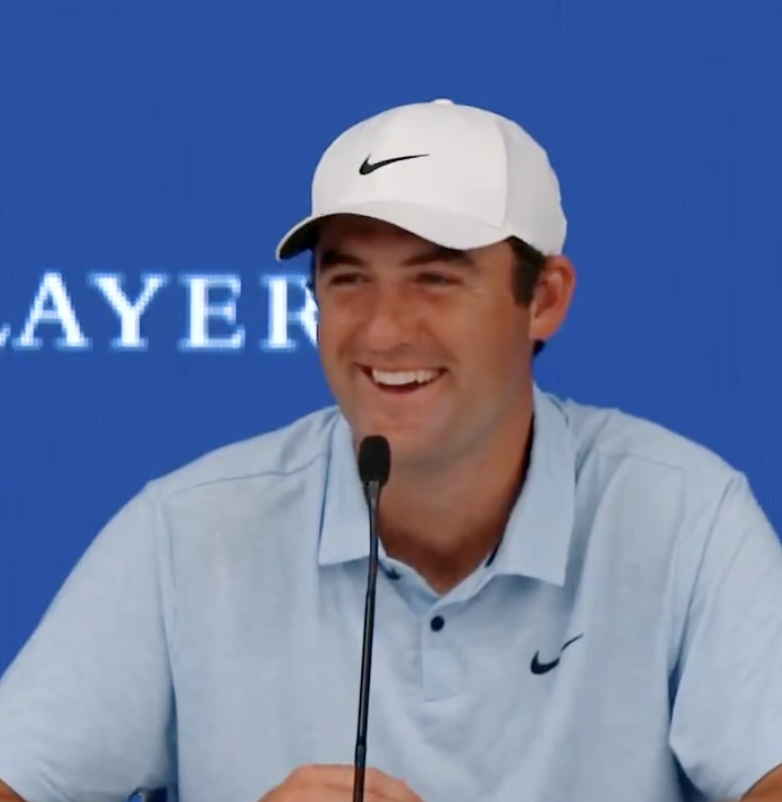
Scottie Scheffler Just Reminded Augusta Who He Is

Saturday, April 11, 2026 | Round 3 — The 90th Masters Tournament
5:33pm EST

I’m just going to start out this post with this…

Twenty-four hours ago, Scottie Scheffler looked like he was playing in someone else’s tournament. A 2-over 74 on Friday, his first over-par round at Augusta since 2023, snapped a streak of 11 consecutive rounds at par or better. He bogeyed both of the back-nine par 5s after finding water at the 13th and 15th. He dropped to even par for the week, a full 12 shots behind Rory McIlroy’s record-setting pace. The two-time Masters champion looked done.

He wasn’t.

Scheffler walked off the 18th green Saturday afternoon having posted a bogey-free 65, matching the lowest round of the tournament. Five birdies. One eagle. Zero mistakes. Nine shots better than Friday. The world’s No. 1 player just played the round of his life at the place he knows best.

The Front Nine That Changed Everything

Scheffler’s front nine was a 31, a career low at Augusta National. It started at the par-5 second hole, where he hit a 7-wood from 265 yards to six feet and converted the eagle putt. Just like that, he was back to 2-under for the tournament after spending Friday afternoon going the wrong direction on the same par 5s that tormented him the day before.

Then came three consecutive birdies at the seventh, eighth, and ninth. His approach at the ninth nearly dropped for eagle. Had it fallen, it would have been a callback to his hole-out eagle on the same hole during the final round of his 2024 Masters win. The lip-out didn’t slow him down.

Five under through nine holes. The early groups hadn’t seen anything like it.

The Back Nine: Staying Clean

The second half of Scheffler’s round was about discipline. He added a birdie at the 11th to move into a share of second place. Another birdie came at the 16th. And at the 18th, where his drive found a tree, he pulled off an escape artist approach that spun back to tap-in range to save par and keep the card clean.

No bogeys. Not one. On a day when Augusta National was expected to play its toughest, 26 of the 42 players who teed off early were under par for the round. But nobody matched what Scheffler did. The course was gettable, and the best player in the world got it.

Why Friday Happened — and Why It Doesn’t Matter Now

Scheffler was honest after Friday’s 74. He pointed to poor decisions rather than poor swings. His 3-iron into the trees at 13. His second shot running through the green and into the water fronting 16 on the 15th hole. He said the margins at Augusta are small, and he was on the wrong side of most of them.

But he also said something that matters more in hindsight: he felt he played better than his score suggested.

He was right. The iron play that won him green jackets in 2022 and 2024 hadn’t disappeared. It was just hiding behind two bad breaks on two par 5s. Saturday proved the talent was still loaded and ready. He just needed the course to stop punishing him and let the quality through.

Scheffler entered this week without a top-10 finish in his last three PGA Tour starts. The pre-tournament narrative focused on whether his form had dipped, whether this was finally the year Augusta would humble him. Through two rounds, it looked like the skeptics had a point. Through three, they’re quiet.

The Math Ahead

Scheffler sits at 7-under, tied for sixth while the later groups are still on the course. McIlroy’s lead, once six shots, has been trimmed to two by Cameron Young and others making charges of their own. Depending on how the afternoon unfolds, Scheffler could enter Sunday’s final round within striking distance of a third green jacket.

If he wins, it would be historic. He’d become the fastest player to three Masters titles in just seven appearances, beating the pace set by Arnold Palmer, Jack Nicklaus, and Tiger Woods, all of whom needed eight. He’d join a club of four players who have won three or more: Nicklaus (six), Woods (five), Palmer (four), and now potentially Scheffler.

After signing his card, Scheffler kept it simple.

“I don’t feel like I’m out of the tournament.”

After a round like that, nobody’s arguing.


Sources: Golf Channel, Yahoo Sports, PGA Tour, CBS Sports — reporting from Augusta National.
Gary Woodland’s Masters Isn’t About Golf Anymore

Gary Woodland drove down Magnolia Lane a little slower this year than he ever has. Slower than his first time in 2011. Slower than the year after he won the U.S. Open. He wanted to feel every second of it because he knows how close he came to never being back.

The 41-year-old arrived at Augusta National this week not just as a former major champion returning to competition, but as a man still fighting a battle that doesn’t care about trophies, rankings, or tee times.


Gary Woodland on His Challenging Journey to Augusta National

The Surgery

In September 2023, surgeons drilled what Woodland described as a baseball-sized hole in the left side of his skull. The operation was to remove a benign lesion on a tract of his brain that had been triggering seizures, anxiety, and fear. Thirty staples closed the wound. Doctors left part of the tumor in place because full removal risked damaging his vision and motor function on his left side.

Five days before the procedure, the reality hit him. “If this goes wrong, I’m dead,” he told ESPN’s Jeff Darlington before tee-off on Thursday. “What if I never play golf again? What if I can’t hold my kids again?”

He wrote letters for his wife Gabby and his children to read in the future, just in case.

He survived. He returned to competitive golf four months later. Everyone assumed the story had its happy ending.

It didn’t.

What Came After

The seizures stopped. The thing that replaced them was worse in a different way. Woodland was diagnosed with PTSD. The hypervigilance, the sensation that he was in physical danger in completely safe environments, persisted long after the surgical scars healed.

He kept it hidden for a long time. Every week on tour, galleries cheered his comeback, celebrated his resilience. He smiled and accepted it. Internally, he was unraveling.

“Every week I come out, and everyone is so excited and happy that I’m back,” Woodland told the Golf Channel earlier this year. “And I appreciate the love and support, but inside, I feel like I’m dying. I feel like I’m living a lie.”

He went public with his diagnosis in March 2026. He said the weight of pretending to be the version of himself everyone wanted to see had become heavier than the truth. Going public, he said, made him feel a thousand pounds lighter.

Houston

Two weeks before the Masters, Woodland entered the Houston Open without a guaranteed spot at Augusta. He’d missed the cut in 2024, didn’t qualify in 2025, and had opened his 2026 season with four missed cuts in his first six events.

Then he won.

The victory itself was remarkable enough. What happened during it was something else entirely. Late in his second round, Woodland’s PTSD took over. For the final ten holes, he was gripped by the conviction that people in the gallery were trying to kill him. He had personal security with him, but the fear was overwhelming.

That night, he called PGA Tour security and told them what he was going through. Every time he looked up for the rest of the weekend, his security team was visible behind him. He played the final two rounds that way and won by five strokes.

The victory clinched the last available spot in the Masters field.

Augusta

Woodland spent part of his week at Augusta meeting with the tournament’s security team. Not about logistics. About survival, at least the way his brain processes it.

“The main deal is they were showing me where security is,” Woodland explained. “The whole deal for me is it’s visual. If I can see somebody, then I can remind myself that I’m safe constantly. So I have a good idea now where security is on every hole.”

He acknowledged that the Masters presents a specific challenge. The galleries at Augusta are close. The tee boxes are tight. There are thousands of people in narrow corridors between holes. For someone whose mind constantly scans for threats, it’s one of the most demanding environments in professional sports.

“It’s a big week for me this week,” he said. “The fans are very close on the tee boxes. There’s a lot going on. There’s probably not a safer golf tournament in the world, so I’m happy for that. But it’s still a battle in my head if I’m safe or not. That’s a tough pill to swallow.”

What Winning Means Now

Woodland was asked after Houston how the win felt. His answer reframed everything.

“The one thing I know is having this brain tumor and having PTSD, it doesn’t matter if I win or lose. It doesn’t care.”

His U.S. Open victory at Pebble Beach in 2019 was the biggest achievement of his golf career. He hopes what happened in Houston, and the decision to be honest about what he’s living with, ends up meaning more.

“I hope somebody that’s struggling with something sees this guy out here fighting every day and still living his dreams, and then they want to get up there and fight and live their dream too.”

Woodland’s Masters this week isn’t really about birdies, bogeys, or where he finishes on the leaderboard. It’s about a man who wrote goodbye letters to his family, survived brain surgery, lived through a year of silent torment, and then chose to stop pretending he was fine.

He drove down Magnolia Lane slower this year because he earned every second of it.

The Realtor Who Played the Masters: Brandon Holtz’s Unlikely Week at Augusta

On a normal Thursday afternoon, Brandon Holtz would be showing a four-bedroom house in Bloomington, Illinois. He’s got one on the market right now for $279,900. But this Thursday, the 39-year-old RE/MAX agent was standing on the first tee at Augusta National Golf Club, wearing his company logo on his collar, about to play in the Masters Tournament.

Here’s his RE/MAX listing for those looking, Brandon Holtz.

His path here makes no sense on paper, and that’s exactly why it matters.

From the Hardwood to the Fairway

Holtz played college basketball at Illinois State from 2005 to 2009. He was a three-point specialist who appeared in 87 games, averaging 2.7 points per contest. Before that, he was the kind of high school athlete small towns talk about for years. He once dropped 68 points in a single basketball game, good enough to earn his scholarship.

Golf was an offseason hobby, something to fill time between travel basketball in the summers. He played on his high school golf team but never traveled for tournaments, never thought of it as a career. That changed after graduation. Holtz turned pro in 2010 and spent several years grinding through mini tours in Florida and Georgia, chasing a dream that the math kept saying wasn’t going to work out.

He couldn’t make a living at it. So he stopped.

The Intermission

Holtz built a life. He sold sports equipment for a while, then pivoted to real estate during the pandemic. The RE/MAX gig in Bloomington gave him a flexible schedule and a steady income, two things professional golf had never provided. He played casual rounds with friends who were solid amateur players, the kind of standing Saturday games that keep you sharp without breaking you.

For most people, that’s where the competitive golf story ends. For Holtz, it was an intermission.

In 2023, he applied to regain his amateur status. By 2024 it was official. Without the financial pressure of chasing a tour card, something clicked. He rediscovered a competitive edge that the grind of mini tours had slowly worn away. In 2025, he won the U.S. Mid-Amateur Championship at Troon Country Club in Arizona. That victory came with two things he never expected to hold in the same hand: an invitation to the Masters and an invitation to the U.S. Open.

From Patron to Player

Here’s the detail that makes this story feel scripted. Holtz’s father Jeff won lifetime Masters badges through the lottery back in 2004. Every April since, the family has made the pilgrimage to Augusta. Brandon knew the grounds intimately. He had a favorite spot behind the sixth green where he’d study pros picking clubs into the wind. He’d make friends, start nearest-to-the-pin bets that began at a dollar and ended at a beer.

He was a fan, and a happy one. Those were someone else’s tournaments.

This week, he walked through the same gates as a competitor. He shared the Par 3 Contest with his six-year-old son Parker. He played practice rounds on the same course he’d watched from behind the ropes for two decades.

The Numbers and the Point

Holtz is ranked 3,262nd in the World Amateur Golf Rankings. The next closest amateur in the Masters field is ranked 112th. He’s the oldest amateur by nearly a decade and significantly older than most of the tournament’s rookies. He told reporters before the tournament that he was realistic about his chances but that he’s a competitor who wanted to make the cut and contend for low amateur honors.

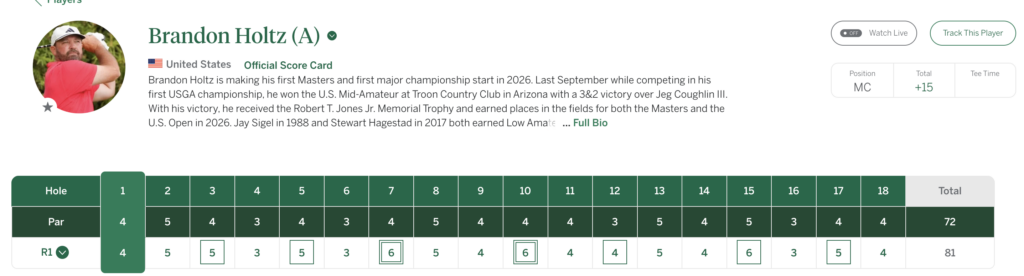
He shot 81 in the first round, hitting from the pine straw on the second hole and fighting Augusta’s back nine the way Augusta’s back nine fights everyone. He missed the cut. The scorecard wasn’t what anyone will remember.

A patron standing near the first tee on Thursday summed it up: “He’s the only guy I said, ‘Do it, man. Come on.’ That guy’s a Cinderella story.”

Why This Story Matters

The Mid-Amateur category in golf has been quietly colonized by country club members with unlimited tee times and schedules built around competition. Holtz learned the game at a nine-hole municipal course in central Illinois where you had to know somebody to get a decent tee time. In the months before Augusta, he told potential real estate clients he couldn’t take them on because he couldn’t give them a fair shake while preparing for the biggest week of his life.

He is the friend in every foursome you’ve ever played: the talker, the gambler, the guy who beats you on the last hole and won’t let you forget it for six months. Most people watching the Masters can’t imagine being Rory McIlroy or Scottie Scheffler. But there are a lot of Brandon Holtzes out there. That’s what made his week at Augusta resonate far beyond the leaderboard.

He’ll go home to Bloomington. He’ll sell that four-bedroom listing. And he’ll have the week at Augusta for the rest of his life.

Brandon Holtz Round 1 at The Masters:

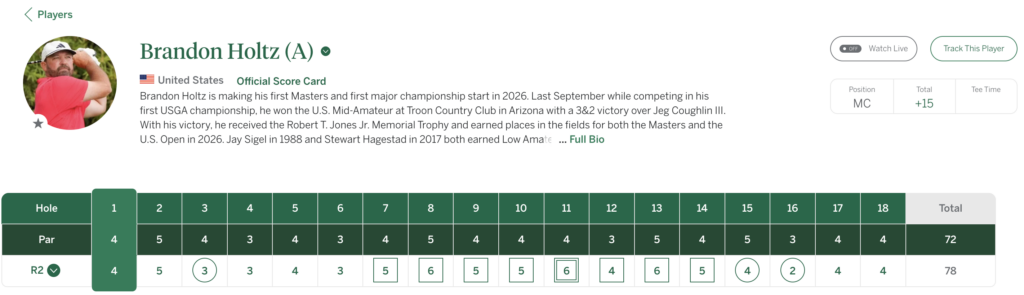
Brandon Holtz Round 2 at The Masters:

3 Things to Know for Saturday at the Masters

Moving day at the 90th Masters Tournament should be fascinating for everyone except maybe Rory McIlroy, who has spent two rounds making it look routine. The defending champion carries a historically large cushion into the weekend at Augusta National.

1. McIlroy Is Running Away With It

Patrick Reed summed up the field’s predicament as he walked off the course Friday: the weekend depends on how Rory finishes. McIlroy answered that question emphatically, birdieing six of his final seven holes, including the last four, to build a six-shot lead at the halfway mark. No one has ever held a bigger 36-hole advantage in Masters history.

McIlroy’s mindset heading into Saturday? Attack, don’t protect. “The next two days for me is really about focusing on myself. Don’t protect it. Go out and play freely. Keep swinging.”

2. History Says the Chasers Need a Miracle

In each of the last 14 Masters, the eventual champion has been within four strokes of the lead after 36 holes. The number of players currently inside that window for McIlroy: zero.

Tommy Fleetwood, tied for fourth but seven shots back, is banking on conditions to create opportunities. The forecast calls for sun, heat, and light wind, which could allow firmer, faster greens to punish even small mistakes from the leader. But right now, the math is brutal for everyone in the field not named McIlroy.

It kinda seems like it’s Rory’s to lose at this point.

3. The Chasing Pack Has Serious Credentials

If any group can manufacture pressure on a dominant frontrunner, this one has the résumés for it. Reed, tied for second, won this tournament in 2018 and owns five career top-10 finishes at Augusta. Sam Burns, alongside Reed at six back, has five PGA Tour victories.

Justin Rose, tied for fourth, is a U.S. Open champion with two Masters playoffs on his record and a current world ranking of ninth. It would be pretty cool to see a Rose/McIlroy playoff again like last year right?

Shane Lowry, also tied for fourth, has an Open Championship to his name. Wyndham Clark, tied for seventh at eight back, adds another U.S. Open title to the mix.

Lowry, who drew a late Saturday tee time, is keeping perspective: there are 36 holes left, and late weekend pairings at Augusta have historically been where runs begin.

Masters Tournament 2026: Round 2 Recap

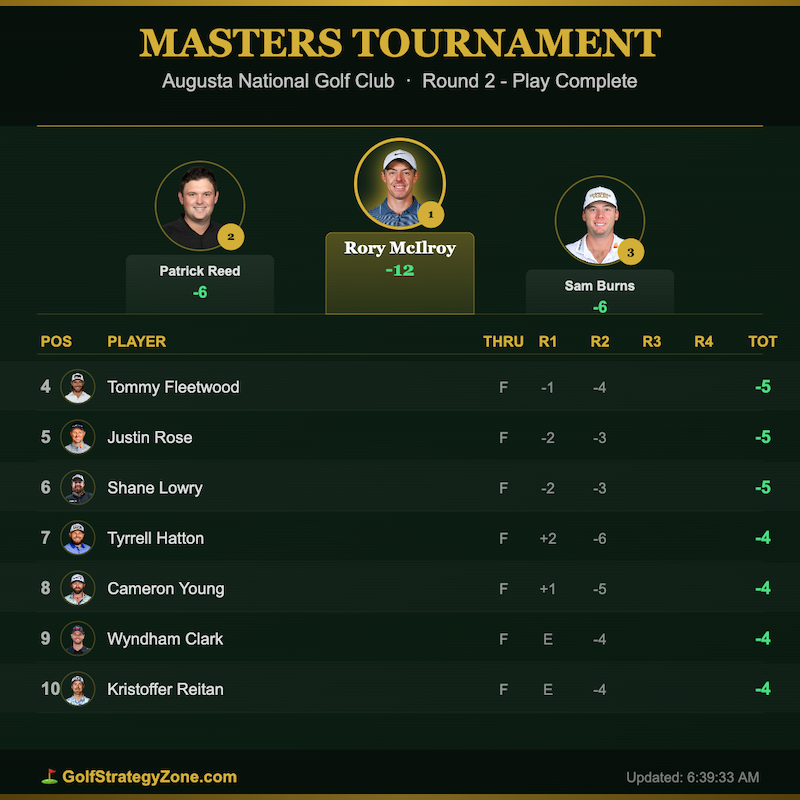
After two rounds of the 90th Masters Tournament, Rory McIlroy sits at 12-under par with a six-shot lead. That’s the largest 36-hole advantage in tournament history. The defending champion, who completed his career Grand Slam here last April, is making a serious bid to become the first player since Tiger Woods to win back-to-back green jackets.

The Leaderboard: Rory’s in a Different Zip Code

Twelve-under through 36 holes at Augusta National is borderline absurd. This isn’t a course that gives away scores like that. McIlroy has been striping it off the tee, hitting greens at will, and converting putts from everywhere. He capped Friday by birdieing six of his last seven holes, including the final four. The guy who agonized over this tournament for a decade before breaking through last year now looks completely at home.

Patrick Reed and Sam Burns are tied for second at 6-under, which tells you everything about the gap McIlroy has opened up. Both have the short-game touch to make a run if he gives them an opening. Behind them, Tommy Fleetwood, Justin Rose, and Shane Lowry are bunched at 5-under. Tyrrell Hatton, Cameron Young, Wyndham Clark, and Kristoffer Reitan sit at 4-under. There’s serious firepower in the chasing pack, but they all need McIlroy to come back to them first.

What Made Round 2 So Special

Augusta National doesn’t hand out rounds like this. A course that punishes the smallest mistake, where a slightly misread putt rolls off the 11th green and a tee shot catches the trees on 13, and McIlroy made it look routine. His iron play into the par-3s was surgical. He seemed to have the greens decoded in a way that usually takes four days, not two. Posting 12-under through 36 holes here puts him in company you can count on one hand.

The Back-to-Back Question

Only three players have ever won consecutive Masters: Jack Nicklaus, Nick Faldo, and Tiger Woods. That’s the company McIlroy is now chasing. Last year’s win was about exorcising a decade of heartbreak at Augusta and locking up the final leg of the Grand Slam. This year is a different kind of test. There’s no monkey on his back, no narrative weight pressing down on every swing. He’s playing free, and the results show it.

The six-shot cushion helps, obviously. But anyone who has watched this tournament knows Augusta can claw strokes back in a hurry. A double at Amen Corner, an aggressive pin chase that rolls into Rae’s Creek, and suddenly six becomes three. McIlroy knows this as well as anyone.

Others to Watch This Weekend

Don’t overlook Justin Rose and Shane Lowry. Both are major champions who know how to grind at Augusta, and at 5-under they’re in the conversation if the front-runners stumble. Rose in particular has a knack for this course, with multiple top-10 finishes to his name and two Masters playoffs on his record.

The wildcard: Kristoffer Reitan. The name won’t ring a bell for most fans, but sitting at 4-under in your Masters debut is seriously impressive. Whether he can handle weekend pressure at Augusta is the open question, but he hasn’t looked intimidated so far.

Looking Ahead to Saturday

Moving day is where this tournament starts for real. McIlroy’s lead looks commanding on paper, but Augusta’s back nine on Saturday has rewritten scripts before. If he stays loose and keeps driving it the way he did Friday, it’s hard to see anyone catching him. But one rough stretch through Amen Corner and the whole complexion changes.

Either way, we’re set for a great weekend at Augusta.