Recent Posts

The Time Chi Chi Rodriguez Drank a Bottle of Rum Before Teeing Off at The Masters

Most golfers who qualify for The Masters spend the night before their first round visualizing fairways, rehearsing their pre-shot routine, maybe eating a quiet dinner. Chi Chi Rodriguez drank an entire bottle of rum.

It was 1961. Rodriguez, a 25-year-old Puerto Rican who had turned pro just the year before, had earned his way into the most prestigious tournament in golf. The invitation came after Augusta chairman Clifford Roberts declared him “The Champion of Puerto Rico.” For a kid who grew up swinging guava tree branches at crushed tin cans in Rio Piedras, walking through the gates of Augusta National should have been a dream fulfilled.

Instead, it was a nightmare of nerves.

Rodriguez later admitted exactly what happened in what’s become one of the most quoted lines in Masters history: he was so anxious that he polished off a bottle of rum before stepping to the first tee. He shot 83 that day, eleven over par, and later called it “the happiest 83” of his life.

He missed the cut. Obviously.

Who Was Chi Chi Rodriguez?

If you only know Chi Chi from that rum story, you’re missing the full picture.

Juan Antonio Rodriguez was born in 1935 into poverty in Puerto Rico. His father worked the sugar cane fields, and Chi Chi was out there alongside him by age seven. He started caddying at eight, teaching himself to play with whatever he could find. By twelve, he’d shot a 67. By seventeen, he’d finished second in the Puerto Rico Open.

After enlisting in the U.S. Army in 1954 and serving two years, Rodriguez came home and landed a job as caddie master at the Dorado Beach Resort. That’s where pro golfer Pete Cooper helped refine his game, and resort co-owner Laurance Rockefeller put up the $12,000 that got him onto the PGA Tour in 1960.

Standing 5’7″ and barely tipping 125 pounds, Rodriguez looked like nobody’s idea of a long hitter. But he had a roundhouse swing that generated distance matching the biggest bombers on Tour, including Jack Nicklaus. He won eight PGA Tour events between 1963 and 1979, highlighted by a one-stroke victory over Arnold Palmer at the 1964 Western Open.

The Showman Augusta Wasn’t Ready For

Chi Chi didn’t just play golf. He performed it.

After sinking a birdie putt, he’d drop his straw Panama hat over the hole “so the birdie doesn’t fly away.” When some players (Palmer among them) told him to dial it back at the 1964 Masters, Rodriguez adapted. He swapped the hat trick for his now-legendary “toreador dance,” wielding his putter like a sword and pantomiming a bullfight, pretending the ball was the bull.

Fans loved it. Some fellow pros didn’t. Rodriguez took the criticism hard. He once said the backlash made him want to hide in his room and do nothing but sleep and go home.

But he kept showing up. Rodriguez played Augusta 14 times total, with his best finishes coming as tied-for-tenth in both 1970 and 1973. He never contended seriously for a green jacket, but that was never really the point.

Where Chi Chi Really Dominated

The Senior PGA Tour (now the Champions Tour) is where Rodriguez’s career truly caught fire. He won three times in his rookie season of 1986, then had a monster 1987 with seven victories, including the Senior PGA Championship. He set records that still stand: four consecutive victories and eight consecutive birdies (the latter coming at the 1987 Silver Pages Classic). He racked up 22 Champions Tour wins total, good for seventh all-time.

In 1991, he lost a playoff to Nicklaus at the U.S. Senior Open. Losing to Nicklaus wasn’t exactly a mark of shame.

He was inducted into the World Golf Hall of Fame in 1992, the first Puerto Rican to earn that honor.

More Than a Golfer

What set Rodriguez apart from most Hall of Famers wasn’t just the trophies or the one-liners. It was what he did with his platform.

In 1979, he founded the Chi Chi Rodriguez Youth Foundation in Clearwater, Florida, nearly two decades before The First Tee existed. The program brought at-risk kids to a local public course for golf instruction, part-time work, and life skills training. It later expanded into the Chi Chi Rodriguez Academy for students who were struggling academically or dealing with difficult personal circumstances. He once said that a man never stands taller than when he bends down to help a child.

He also bought his mother a house and financially supported his siblings back in Puerto Rico.

Rodriguez passed away on August 8, 2024, at age 88. The tributes poured in from the PGA Tour, the USGA, and the broader golf world, all noting that his generosity off the course mattered at least as much as anything he did on it.

The Lesson for Your Game

Here’s what the rum story actually teaches us, beyond being a great bar anecdote: even elite professionals get rattled by the moment. Rodriguez was a supremely talented ball-striker who could outdrive players twice his size. None of that mattered when his nerves hijacked his body at Augusta.

The difference between Rodriguez and most golfers who choke under pressure? He came back. Thirteen more times. He figured out how to manage the anxiety (without the rum), developed routines that let his personality work for him instead of against him, and built a career that spanned three decades of competitive wins.

If you’re struggling with first-tee jitters at your Saturday Nassau, just remember: a future Hall of Famer once needed a bottle of Bacardi to walk onto the first tee at Augusta. You’re in good company.
From Brain Surgery to Champion: Gary Woodland’s Incredible Houston Open Victory

From Brain Surgery to Victory: Gary Woodland’s Incredible Comeback at the 2026 Houston Open

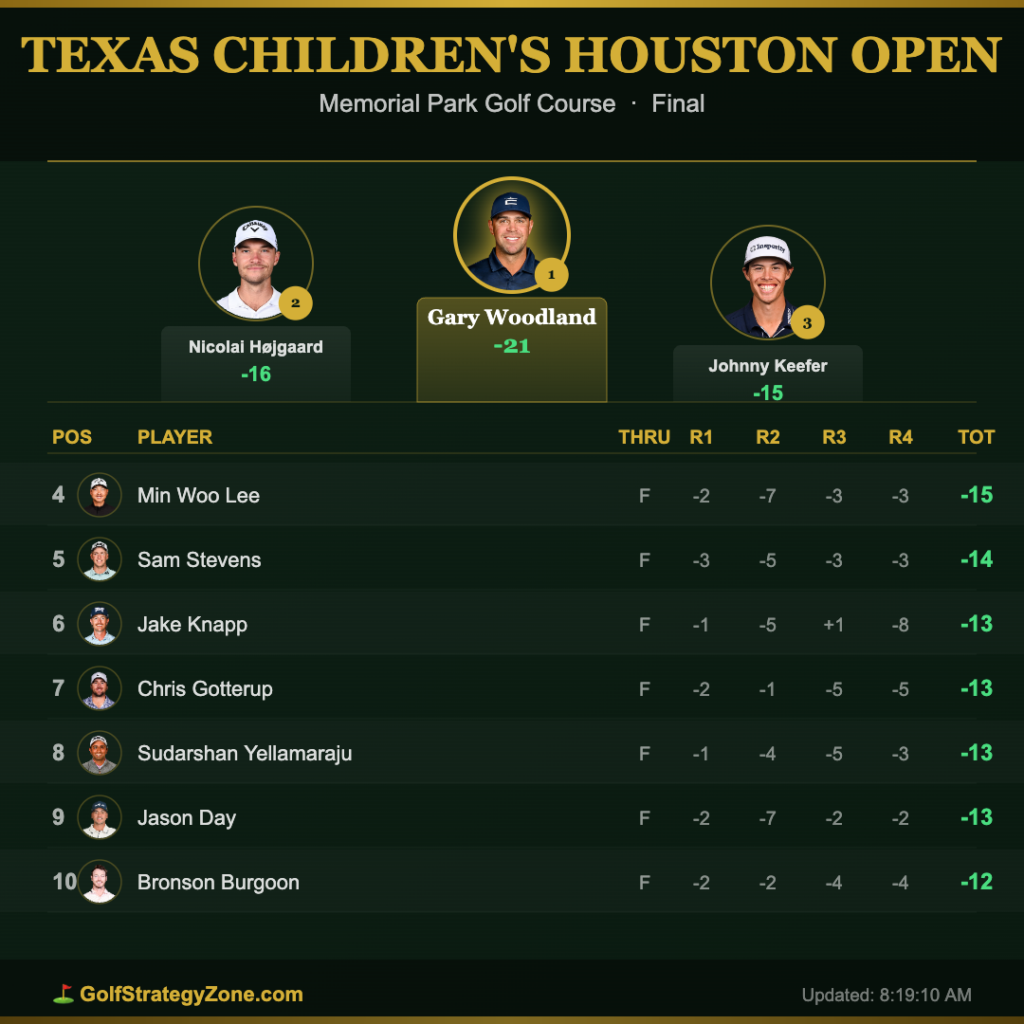
Thirty months ago, Gary Woodland was lying on an operating table with a baseball-sized hole cut into his skull. Surgeons were carefully removing a brain lesion that had been causing him terrifying symptoms — hand tremors, chills, and waves of intense fear and anxiety that jolted him awake at night. On Sunday at Memorial Park, that same man stood on the 18th green, stretched both arms toward the sky, and wept. He had just won the Texas Children’s Houston Open at 21-under par, his first PGA Tour victory in nearly seven years. This wasn’t just a golf tournament. This was one of the most remarkable comeback stories in the history of professional sports.

The Diagnosis That Changed Everything

To fully appreciate what happened at Memorial Park this week, you have to understand what Woodland has been through. In May 2023, Woodland was diagnosed with a brain lesion located on the part of his brain that controls fear and anxiety. The lesion was causing unfounded feelings that he was dying. By September 2023, he underwent a craniotomy — brain surgery — to remove the tumor. Surgeons were able to remove a significant portion, though some was intentionally left behind to protect his vision and left-side mobility. The tumor was ultimately confirmed to be benign, but the damage to his life and career was already enormous.

Woodland returned to the PGA Tour in January 2024 at the Sony Open in Hawaii, just months after having his skull opened up. Think about that for a moment. Most people take months just to feel normal after brain surgery. This man was competing against the best golfers on the planet. He was runner-up at last year’s Houston Open, showing flashes of his former self, but behind the scenes, things were far from okay.

The Hidden Battle: PTSD and the Decision to Speak Up

Just two weeks before this tournament, Woodland revealed in a Golf Channel interview that he had been diagnosed with post-traumatic stress disorder following his surgery. He described feeling “hypervigilant” and anxious, particularly when people were behind him. He once rushed to a portable bathroom on the course just to break down in tears, overwhelmed by emotion he could not control. In what might be the most courageous moment of his career — and that’s saying something for a U.S. Open champion — Woodland chose to go public with his struggles. He said that going public made him feel “1,000 pounds lighter,” and it showed this week in Houston.

How Woodland Dominated Memorial Park

Woodland didn’t just edge out the field — he dismantled it. His week was a masterclass in ball-striking, course management, and mental fortitude, made all the more astounding given what his brain has been through. Here’s how his four rounds unfolded:

  • Round 1 — 64 (6-under): A bogey-free opening statement that immediately put the field on notice. Woodland looked comfortable and controlled from the first tee, his iron play precise and his putting stroke smooth.
  • Round 2 — 63 (7-under): Woodland went even lower on Friday with aggressive yet controlled iron play. He started pulling away from the field, building the kind of momentum that championship winners ride.
  • Round 3 — 65 (5-under): Moving Day is where pretenders fade and contenders rise. Woodland simply solidified his position, maintaining composure despite the pressure from chasers. He took a one-shot lead over Højgaard into the final round.
  • Round 4 — 67 (3-under): Woodland closed with a 67 to finish at 21-under 259 — a 72-hole tournament scoring record. He won by five shots over Nicolai Højgaard, who himself closed with a 71.

His ball speed reached 196 mph on one tee shot Sunday, proving that the physical power that once made him one of the longest hitters on Tour had fully returned. He also consulted coach Randy Smith before the tournament and switched to stiffer shafts in his irons because his speed was back, giving him tighter control over his approach shots. He also went to a new putter to help his alignment. Small tweaks, massive results.

An 18th Hole That Brought the Golf World to Tears

The final hole was something special. As Woodland walked up the 18th fairway, the gallery chanted his name — then went silent so he could roll in a five-foot par putt to seal it. He stretched both arms out, exhaled, looked up at the sky, and the tears started pouring. In a moment of sportsmanship you almost never see outside of major championships, runner-up Nicolai Højgaard and defending champion Min Woo Lee deliberately held back on their walk to the 18th green to give Woodland the stage to himself.

What This Win Means for Woodland’s Career

The victory is Woodland’s fifth career PGA Tour win, and his first since the 2019 U.S. Open at Pebble Beach. That six-year, 286-day gap between wins is the fourth-longest stretch in the past 40 years from a major victory to a player’s next PGA Tour win. Perhaps most importantly, the win earns Woodland an invitation to the Masters, which is just two weeks away. He also jumps to No. 51 in the world rankings — his highest position in five years — and becomes eligible for all of the PGA Tour’s remaining elite events this season.

What Golfers Can Learn from Woodland’s Journey

Beyond the incredible human story, there are real takeaways here for golfers at every level. Woodland’s willingness to adapt his equipment — switching to stiffer shafts once his swing speed returned, and changing putters to fix his alignment — is a reminder that your setup should evolve as your game changes. Too many amateurs play the same gear for years without getting re-fitted. Woodland also demonstrated that course management wins tournaments. He didn’t try to overpower Memorial Park. He played smart, took what the course gave him, and avoided the big mistakes that derail rounds. That’s a strategy any golfer can adopt this weekend.

Gary Woodland’s win at the 2026 Texas Children’s Houston Open transcends golf. It’s a story about a man who had his skull cut open, battled invisible demons, chose vulnerability over silence, and then went out and set a tournament scoring record. If that doesn’t inspire you to go work on your game — or just keep fighting through whatever challenge you’re facing — nothing will. We’ll be watching closely when Woodland tees it up at Augusta National in two weeks. Something tells us this story is far from over.

Tiger Woods Involved in Rollover Crash on Jupiter Island — Masters Status Now in Serious Doubt

Update, March 28, 9:30 a.m.: Woods was released from Martin County Jail late Friday night after being held for approximately eight hours. He has been charged with DUI, property damage, and refusal to submit to a lawful test. Full details below.

Update, 3:41 p.m.: Martin County Fire Rescue reports no injuries to anyone involved in the crash.

Tiger Woods was arrested and charged with driving under the influence on Friday afternoon after being involved in a rollover crash on Jupiter Island, Florida, just after 2 p.m. near the 280 block of South Beach Road. The Martin County Sheriff’s Office confirmed the incident, and Sheriff John Budensiek held a press conference later that evening with full details of the crash and arrest.

How the Crash Happened

According to Sheriff Budensiek, a pickup truck pulling a pressure-washing trailer was traveling northbound on South Beach Road, where the speed limit is 35 mph, and was beginning to turn into a driveway. The truck’s driver looked in his rearview mirror and saw Woods’ dark Range Rover approaching at high speed. As the truck driver tried to get off the road, Woods’ SUV swerved left to avoid the truck but clipped the back of the trailer. The collision caused the Range Rover to roll onto the driver’s side and slide some distance before coming to rest.

Woods, 50, was able to climb out through the passenger-side window. Neither he nor the truck driver were injured, and there were no other occupants in either vehicle. Budensiek noted the outcome could have been far worse had there been oncoming traffic on the two-lane road.

DUI Arrest and Charges

Responding officers suspected Woods was impaired. Budensiek described Woods as “lethargic” and said he showed signs of impairment. DUI investigators were called to the scene and conducted roadside tests that took into account Woods’ injury history and physical limitations.

Woods submitted to a breathalyzer test and blew “triple zeroes,” confirming that alcohol was not a factor. However, he refused to provide a urine sample. Budensiek said investigators believed Woods was under the influence of some type of medication or drug. Woods told officers he had taken medication for prior injuries.

He was arrested at the scene, booked into Martin County Jail, and held for approximately eight hours, consistent with Florida law requiring a minimum incarceration period following a DUI-related arrest. Woods was released late Friday night. In addition to the DUI charge, he faces one count of property damage and one count of refusing to submit to a lawful test.

What This Means for the Masters

The timing could not be worse for golf fans. Woods competed in the TGL championship earlier this week, marking his return to competitive golf after rupturing his Achilles last year. He’s also been recovering from his seventh back surgery, performed last October. Despite all that, Woods was still listed as an invitee to the 2026 Masters, which begins in less than two weeks, though he had been noncommittal about whether he would play. He also hasn’t competed in a PGA Tour event since the 2024 Open Championship.

Earlier on Friday, before the crash, it was reported that Woods had entered this summer’s U.S. Senior Open, his first entry into a PGA Tour Champions major. That news has been overshadowed entirely by the afternoon’s events. No official Masters withdrawal has been announced, but the DUI arrest throws his participation into serious doubt.

A Pattern of Incidents

This is not the first time Woods has faced legal trouble or been involved in a serious car incident. Here is a timeline of the major incidents:

  • November 2009 — Woods struck a fire hydrant and a tree outside his home in Florida, an incident that preceded the unraveling of his personal life and a lengthy absence from professional golf.
  • May 2017 — Woods was arrested for DUI near his Jupiter home after police found him asleep behind the wheel of a parked vehicle. He was not involved in a crash, but the arrest revealed he had been taking prescription medication. He later checked himself into a clinic for treatment.
  • February 2021 — A single-car rollover in Southern California at more than twice the posted speed limit. Woods suffered severe leg injuries requiring multiple surgeries and was sidelined until the 2022 Masters. Authorities said there were no signs of impairment at the time, though investigators faced scrutiny for not obtaining a blood sample.
  • March 2026 — Today’s two-car rollover crash on Jupiter Island, resulting in a DUI arrest and three charges. Alcohol was ruled out, but investigators believe medication or drugs were involved.

What to Watch For

If you’re tracking Masters odds or fantasy golf lineups, this is a situation to monitor very closely. Key things to watch in the coming days include whether Woods officially withdraws from the Masters, any statement from Woods or his management team at Excel Sports, details on the specific substance involved, and whether additional legal consequences follow.

We’ll continue to update this post as new information becomes available.

This is a developing story. Last updated March 28, 2026, 9:30 AM ET.

Sources: NBC News, Golf Channel, WPTV, ESPN, ABC News, CNN, Golf Digest, Fox News, Local 10 (WPLG)

Tiger Woods’ Jet Was Spotted in Augusta

Golf Twitter went into full detective mode over the weekend when Tiger Woods’ private jet was tracked landing near Augusta, Georgia.

With the 2026 Masters just three weeks away, speculation about a Tiger comeback immediately exploded. And who could blame anyone for jumping to that conclusion?

The reality is a lot more mundane, and honestly, a lot more wholesome.

The Actual Reason Tiger Was in Augusta

Tiger’s 17-year-old son Charlie was competing in the Junior Invitational at Sage Valley Golf Club in Graniteville, South Carolina, roughly 20 miles from Augusta National. The tournament ran through Saturday, March 14, and Tiger was there doing what any golf dad would do: watching his kid compete.

Charlie had a brutal week on the scorecard, posting rounds of 75-76-83-80 to finish at 26-over par (314 total), last in the 36-player field. For context, the winner — top-ranked junior Miles Russell — finished at 15-under. That’s a 41-shot gap. Sage Valley is a monster of a course, though, and the field is stacked with the best junior players on the planet. Past champions include Scottie Scheffler (2014), Joaquin Niemann (2017), and Akshay Bhatia (2018).

Despite the tough results, Charlie’s trajectory has been impressive. He’s climbed from 604th to 20th in the Rolex AJGA rankings in just one season, recently signed with Players Group Management for his first representation deal, and has committed to play college golf at Florida State starting in 2027. Interestingly, Russell — the guy who just beat him by 41 shots — is also headed to Florida State.

But About That Masters Question…

The jet-tracking drama would be less interesting if Tiger had firmly ruled out Augusta. He hasn’t. At last month’s Genesis Invitational press conference, he was asked directly whether the Masters was off the table. His answer was a one-word “no,” followed by what reporters described as a wide grin.

That’s classic Tiger… give just enough to keep everyone guessing.

Here’s what we actually know about his physical condition. He underwent disc replacement surgery (his seventh back procedure) in October 2025. That came roughly seven months after repairing a ruptured left Achilles tendon. Two major surgeries within a calendar year, at age 50.

He told reporters at the Genesis that he’s progressed to hitting full shots, though he acknowledged the results are inconsistent and his body is still sore from the disc replacement. He compared his timeline to Will Zalatoris’ recovery from a similar procedure, noting that at 50, his own recovery would likely take longer.

His last competitive round on the PGA Tour was at the 2024 Open Championship at Royal Troon. His last Masters appearance, also in 2024, saw him extend his record of consecutive cuts made to 24 — but he finished 60th out of those who played the weekend, shooting 16-over for the tournament.

The Champions Tour Angle

One new wrinkle since Tiger turned 50 on December 30: he’s now eligible for the PGA Tour Champions circuit, where players are allowed to use golf carts. Tiger has always refused to use a cart on the PGA Tour, calling it a matter of principle. But he acknowledged at the Genesis that the Champions Tour presents a different calculus. He described riding in a cart on that circuit as an “opportunity” he’s thinking about.

This matters strategically. If Tiger’s body can’t hold up for 72 holes of walking at Augusta, and recent history suggests that’s a real concern, the Champions Tour offers a competitive outlet where he doesn’t have to choose between his health and his desire to compete.

It could also serve as a proving ground: play a Champions Tour event with a cart first, assess where the game stands, then decide about walking 72 holes at a major.

What to Actually Expect

If you’re wagering or building fantasy lineups around a Tiger Masters appearance, temper your expectations. The smart read on the situation:

  1. Tiger hasn’t committed to playing. A one-word “no” when asked if it’s “off the table” is not the same as saying yes.
  2. The surgery timeline is tight. Five months post-disc replacement for a 50-year-old who’s had seven back surgeries is not a lot of runway.
  3. He’s also weighing the Ryder Cup captaincy. The PGA of America has asked for his input on potentially captaining the 2027 team at Adare Manor. That decision is still pending.
  4. If he does play, set realistic expectations. His 2024 Masters showed flashes of his old self, but the physical toll was visible over four rounds. Those hills at Augusta are no joke.

The Masters begins April 9. Tiger has confirmed he’ll attend the Champions Dinner, hosted this year by defending champion Rory McIlroy. Whether he’s there as a former champion or as a competitor remains the most compelling open question in golf right now.

One thing is certain: if Tiger does tee it up at Augusta, no one on the property will be watching Charlie’s Sage Valley scorecard. Every eye will be locked on the Big Cat.

Bourbon Arnold Palmer Recipe for Masters Week

If you want a golf drink that is simple, familiar, and a little stronger than the classic version, the Bourbon Arnold Palmer is the obvious next move.

Most people already know the regular Arnold Palmer: half iced tea, half lemonade. Add bourbon, and it becomes a better fit for a golf watch party, a backyard Masters gathering, or a post-round drink at home.

It is not the flashy pink Azalea, and it is not the country-club Transfusion. It sits right in the middle: easy to make, easy to drink, and instantly recognizable.

What Is a Bourbon Arnold Palmer?

A Bourbon Arnold Palmer is a boozy twist on the classic Arnold Palmer drink made with iced tea and lemonade.

The bourbon gives it more depth and a little bite, while the tea and lemonade keep it light and refreshing. That balance is what makes it work so well for golf fans. It feels casual, but not cheap. It feels familiar, but not boring.

Bourbon Arnold Palmer Recipe

Ingredients

  • Ice
  • 2 oz Bourbon
  • 3 oz Iced Tea
  • 3 oz Lemonade
  • Garnish with Lemon Wheel

How to Make a Bourbon Arnold Palmer

  1. Fill a glass with ice.
  2. Pour in the bourbon.
  3. Add the iced tea.
  4. Add the lemonade.
  5. Stir gently.
  6. Garnish with a lemon wheel or lemon slice.

That is it. Clean, simple, and hard to screw up.

What Does a Bourbon Arnold Palmer Taste Like?

This drink is smooth, slightly sweet, a little tart, and more balanced than most people expect.

The lemonade gives it brightness.
The tea gives it structure.
The bourbon gives it warmth and a stronger finish.

If you use a decent bourbon and cold ingredients, it tastes like a proper golf-week drink instead of something thrown together at the last second.

Why This Works for Golf Fans

This drink fits a golf audience because it already feels connected to the sport.

Even people who do not drink or know golf know the Arnold Palmer name. That gives this recipe instant familiarity. Adding bourbon turns it into something more adult and more suited for a tournament watch party.

It also works because:

  • it is easy to make
  • it uses ingredients people already have
  • it feels classy without being pretentious
  • it makes a great companion post to your Azalea cocktail article

Bourbon Arnold Palmer vs. Azalea

These are two very different golf-week drinks.

The Azalea is more colorful, more visual, and more tied to Masters-week aesthetics.

The Bourbon Arnold Palmer is simpler, more recognizable, and easier for the average person to make without buying anything unusual.

If the Azalea is the themed tournament drink, the Bourbon Arnold Palmer is the dependable crowd-pleaser.

Tips for Making the Best Bourbon Arnold Palmer

Use cold tea and lemonade

Do not rely on ice to do all the work. Start cold.

Do not use overly sweet tea

If the tea is too sugary and the lemonade is sweet too, the drink gets sloppy fast.

Pick a bourbon that is smooth, not harsh

This is not the place for something that drinks like lighter fluid.

Keep the ratio balanced

Too much bourbon overwhelms the tea and lemonade. The point is balance, not punishment.

Best Food Pairings

This drink goes well with golf-watch-party food, including:

  • burgers
  • barbecue
  • grilled chicken
  • pimento cheese sandwiches
  • chips and dip
  • wings

It is broad enough to work with almost anything casual.

Final Thoughts

If you want another golf-themed drink to follow your Azalea post, this is a smart choice.

The Bourbon Arnold Palmer is simple, recognizable, and easy for readers to make at home. It also gives you a different angle from the Azalea and the Transfusion, which matters if you want a real content series instead of repetitive posts.

For Masters week, this is one of the easiest wins.


Recipe Card

how to make a bourbon arnold palmer for golf parties

Bourbon Arnold Palmer

Ingredients

  • Ice
  • 2 oz Bourbon
  • 3 oz Iced Tea
  • 3 oz Lemonade
  • Garnish with Lemon Wheel

Instructions

  1. Fill a glass with ice
  2. Add bourbon
  3. Add iced tea
  4. Add lemonade
  5. Stir gently
  6. Garnish with lemon wheel

Who Is Sudarshan Yellamaraju? The Self-Taught PGA Tour Rookie

If you watched The Players Championship this weekend, one name probably caught you off guard.

Not Schauffele. Not Fitzpatrick. Not Aberg.

Sudarshan Yellamaraju.

The 24-year-old PGA Tour rookie from Mississauga, Ontario fired a bogey-free 66 in Saturday’s third round at TPC Sawgrass, then backed it up with a 68 on Sunday to finish tied for fifth at 9-under. His first career top-10 finish on the PGA Tour. And he did it at the biggest non-major in golf, surrounded by the best players on the planet.

But the score isn’t the real story. The path that got him there is.

Born in India, Built in Canada

Yellamaraju was born in Visakhapatnam, a port city on the southeastern coast of India. His father, Suresh, worked in a high-rise office that overlooked a golf course, but the family had zero connection to the sport. Golf was just something Suresh turned on the TV to fall asleep to.

Except his toddler son wouldn’t fall asleep. He’d sit next to his dad, glued to European Tour broadcasts, watching every swing.

When Sudarshan was four, the family emigrated from India to Winnipeg, Manitoba. A couple of years later, at age six, young Sudarshan picked up his first golf clubs: a plastic set. He’d hit range balls with oversized rental clubs at The Golf Dome, a local indoor facility in Winnipeg. The clubs had steel shafts, were way too long, and had tiny heads. None of that mattered.

By age nine, his parents bought him a proper junior set. He also attended a 10-day Future Links camp through Golf Canada. That same year, he entered his first 18-hole tournament. He shot 101 in the opening round, followed by a 99. To this day, those remain the only rounds he’s ever shot over 100.

YouTube Was His Swing Coach

Here’s where the story gets unusual for a PGA Tour player. Yellamaraju never took a formal golf lesson. Not as a kid. Not as an amateur. Not now.

He and his dad learned the game together by watching Tiger Woods, Rory McIlroy, and Phil Mickelson on YouTube and on TV. They’d film Sudarshan’s swing, put it side-by-side with the pros on screen, and try to match what they saw.

That’s it. That was the coaching infrastructure.

Even today, he doesn’t have a full-time swing coach. His caddie, Joel Craft, and his father still serve as his primary feedback loop. His dad plays golf maybe once a year, but he grew up playing cricket and understands weight transfer and swing mechanics at an intuitive level.

Yellamaraju describes himself as a “feel” player. He doesn’t get buried in technical swing data or rely heavily on launch monitors and training devices, though he does use them. His game was built on observation, repetition, and feel.

Winning Young, Skipping College

When Sudarshan was 11, the family moved from Winnipeg to Mississauga, Ontario, in the Greater Toronto Area. He was homeschooled and poured his energy into competitive junior golf.

At 16, he entered the Ontario Men’s Amateur as the youngest player in the field. He won. He birdied the final hole to avoid a playoff and claim one of the biggest amateur titles in Canadian golf.

College offers came in, but none with enough scholarship money to make it work financially. Instead of taking on debt, he made a bold call: skip college entirely and turn pro.

COVID-19 delayed his original plan to turn professional straight out of high school in 2020. So he spent time playing amateur mini-tour events near his family’s home in Ontario, honing his game without sponsors and funded entirely by his parents.

He officially turned professional in 2021, at 19 years old.

Grinding Through the Ranks

Yellamaraju’s early pro career was a masterclass in persistence on a shoestring budget.

He started on mini tours, then spent 2022 and 2023 on PGA Tour Canada (now PGA Tour Americas). He only had conditional status that first year and skipped several Monday qualifiers early on just to save money. When he finally did enter a Monday qualifier, he made eagle in a playoff to earn his spot. He made the cut in that tournament and used the momentum to eventually earn full status on the Canadian tour.

From there, he earned Korn Ferry Tour status for 2024. His rookie KFT season was rough. He finished 99th in the season-long points list. He had to go all the way back to first-stage qualifying school that fall. He fought through to the final stage, finishing tied for 36th, which earned him eight guaranteed starts on the Korn Ferry Tour for 2025.

It only took him two starts to change everything.

The Bahamas Breakthrough

In January 2025, at the Bahamas Great Abaco Classic, Yellamaraju won his first professional title. He didn’t miss a single green or fairway in the final round, went 5-under through his first nine holes, and cruised to a five-shot victory over Kensei Hirata. The winner’s check: $180,000.

It happened on his father’s birthday.

“It’s rare to have a tournament, in January, where we play a final round, on his birthday. It just all fell into place,” he told reporters afterward.

That win was the turning point. It gave him enough Korn Ferry Tour points to stay in contention for a PGA Tour card all season long. Heading into the final KFT event of the year, the KFT Championship in French Lick, Indiana, he sat 20th in the standings. Only the top 20 earned PGA Tour cards.

He played steady all week, shooting three consecutive rounds of 71. Then bogeyed three straight holes on Sunday from 14 through 16. He had to par his final two holes to hold on. He did. He finished 19th in the final standings and punched his ticket to the PGA Tour for 2026.

Arriving at the Big Stage

In his rookie PGA Tour season, Yellamaraju has made the cut in five of his first six starts. His best finish before The Players was a T-13 at the Sony Open in Hawaii, where windy conditions played to his strengths.

His stats paint a picture of a well-rounded player. He ranks 16th on Tour in driving distance at 315.3 yards. His strokes gained off-the-tee sits at 0.365 (39th), approach the green at 0.312 (47th), and putting at 0.359 (45th). He’s 67th in FedExCup points heading into The Players.

Solid across the board. Not a one-dimensional player.

Then came TPC Sawgrass.

His bogey-free 66 on Saturday moved him up the leaderboard and into contention alongside names like Ludvig Aberg, Xander Schauffele, Matt Fitzpatrick, and Tommy Fleetwood. On Sunday, he posted a 4-under 68 to finish T-5 at 9-under, four shots behind winner Cameron Young.

“I knew my good game had not come yet. I knew I had to stay patient. Today kind of finally it came,” Yellamaraju said after Saturday’s round.

After Sunday, he reflected on what the week meant for his confidence: “I know I can compete and contend, and I have a lot of belief in myself, but that results-based confidence is something you can’t match. Once you do something, you know you can do that or better.”

Why This Matters

Golf is a sport that had historically rewards a specific pipeline: affluent family, junior academy, college golf at a Division I powerhouse, then the pro ranks. The system works. It produces incredible players.

But every once in a while, someone breaks through from completely outside that pipeline. Yellamaraju is a left-handed, self-taught, India-born, YouTube-educated, homeschooled kid who couldn’t afford college golf scholarships and turned pro at 19 with his parents as his only sponsors. Five years later, he’s finishing top-5 at The Players Championship.

He’s proof that if you can shoot the scores, the meritocratic structure of professional golf will eventually find you.

At 24, with his world ranking set to climb well above his current No. 216, Sudarshan Yellamaraju is a name every golf fan should know. Because this kid isn’t going anywhere. He’s just getting started.


Sources: PGA Tour, Golf Canada, The Fried Egg, ESPN, Golf Monthly, CBC Sports, NBC Sports, TSN

Titleist Next on the Tee Episode 1: Sudarshan Yellamaraju